
How I Styled Our Kitchen Table to Feel Finished—Not Staged
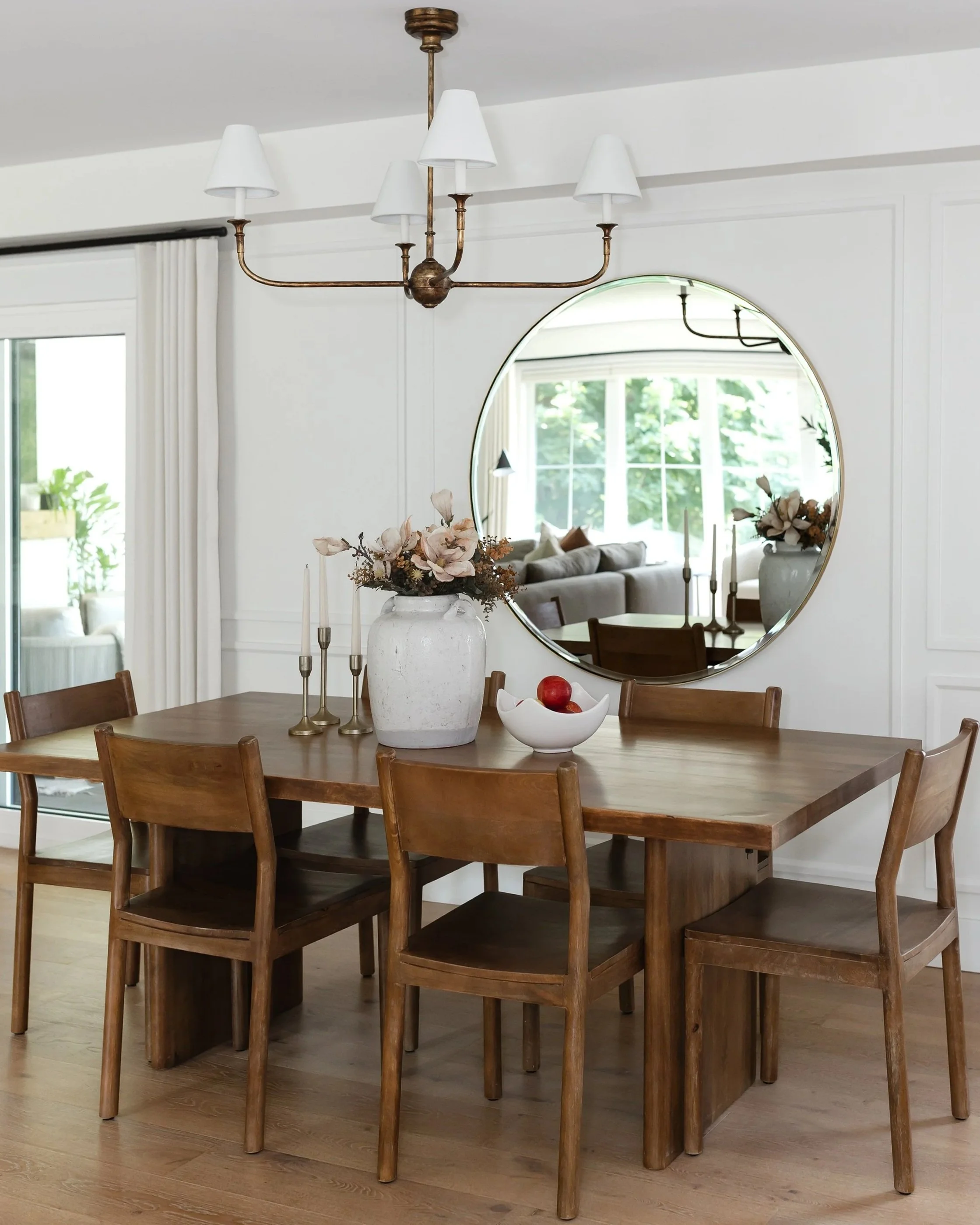
A kitchen table can feel beautiful without feeling untouchable. A few simple layers were all mine needed to finally feel finished—while still leaving plenty of room for everyday life.
For seven years, our kitchen table was pretty much just that: a kitchen table. We ate there, the kids sat there, things inevitably got dropped there on their way somewhere else, but despite how much I love decorating our home, I never really styled it.
I always wanted to. I've saved plenty of kitchen table styling and home decor ideas over the years, and I love the look of a beautiful kitchen or dining table with flowers, candlesticks and just enough on it to make the whole space feel inviting. But so many of the tables I saw for inspiration felt a little too perfect. Too arranged. Sometimes almost untouchable. And that has never been how I want our home to feel.
If I had to describe my design philosophy in one sentence, it would probably be this: I want our home to look finished without looking staged. I want it to feel warm and collected and lived in. I want beautiful things around us, but I don't want anyone wondering whether they're allowed to move them, and I definitely don't want to dismantle an elaborate centrepiece every night before my family can sit down for dinner.
So, for a very long time, the table stayed empty.
The Chandelier That Finally Got Me Started
I'd known for years that the table needed a light fixture above it. It was one of those things on the house list that I simply never got around to doing. Then, after seven years, I finally ordered a chandelier, and something about seeing it arrive suddenly made me excited about finishing the table underneath it too.
Maybe that's because lighting has a way of giving a dining table a sense of place. A kitchen table is a large, heavy, horizontal piece of furniture. Add the chairs around it and there's a lot of visual weight concentrated fairly low in the room. A chandelier draws your eye upward, adds another layer and can balance all that heaviness below with something lighter and more delicate overhead. It can add elegance to an otherwise very functional piece of furniture without making the space feel formal.
I think lighting becomes even more important in an open-concept home, where there may not be four walls telling you where the dining area begins and ends. A chandelier can do some of that work instead. It visually anchors the table, creates a little dining zone within a larger living space and connects what's happening at table level to the rest of the room.
Then there is what happens at night. Good lighting isn't just another decorative element. Dim the chandelier, light a couple of candles and an ordinary family dinner can suddenly feel a little warmer and more intimate. The table becomes somewhere you actually want to sit for a while longer, which, to me, is a much better reason to think carefully about lighting than simply because a dining table is "supposed" to have a chandelier above it.
Why an Empty Kitchen Table Can Make a Room Feel Unfinished
I think kitchen table styling matters even more now since kitchen tables are often right in the middle of our living spaces and are no longer tucked away in dining rooms that we enter only at mealtime. They're part of our everyday living spaces. We see them from the kitchen, from the living room and as we walk through the house. Even if we're only sitting down to eat there a few times a day, we're looking at the table all day long.
And a bare table is a lot of surface space that can make a large piece of furniture feel even heavier. There is all that wood, all those straight lines and all that uninterrupted horizontal space. In a room where everything else has been softened with textiles, plants, books, art and other layers, a completely bare table can almost feel disconnected from the rest of the living space.
Adding a few carefully chosen things changes that. Flowers or greenery introduce movement and softness, candlesticks bring height, and a bowl introduces another shape and texture. Suddenly the table doesn't feel like a big functional object sitting within the room. It feels like part of it.
For me, that's really the point of everyday kitchen table decor. I'm not trying to create a centrepiece that people admire from a distance. I'm trying to soften a substantial piece of furniture and make it feel more inviting while still letting it function exactly as it needs to for our family.
I Don't Start With a Decorating Shopping List
This project also reminded me of something about the way I decorate. I don't usually decide I'm going to tackle an area of our house and then make a shopping list of all the things I'm supposed to buy for it. My process is slower and much less formulaic than that. I tend to make one change, look at the room again and respond to what I think it needs next.
In this case, the chandelier was what got me started. Once I'd finally made that decision and could see what was happening above the table—the scale, height, shape and visual weight—I could start thinking about what felt right underneath it. I didn't want to copy one of the home styling ideas I'd saved or recreate a centrepiece I'd seen somewhere else. I wanted to figure out what worked on this particular table, under this particular light, in our particular home.
That's generally how our house has come together. I'd much rather live with something for a while and notice what's missing than buy five accessories because a decorating formula says I need them. Sometimes a space needs height. Sometimes it needs something organic, a little texture or some warmth. And sometimes what it really needs is for you to stop adding things.
As I started putting this table together, I also realized I didn't need a lot of different colours or materials to make it interesting. The large white vase gives the arrangement volume, the candlesticks add height and the smaller bowl stays low to the table. Their shapes and heights are different, but the palette is restrained, which keeps everything from feeling busy. The brass candlesticks also subtly pick up the finish of the chandelier above, helping the tabletop and light fixture feel connected without making everything match.
I think decorating this way is part of what allows a home to feel collected over time rather than decorated all at once.
The Everyday Kitchen Table Decor I Keep Coming Back To
Once I actually started thinking about what I wanted on our table, I realized my favourite dining table centrepiece ideas are incredibly simple: flowers or greenery, candlesticks and a beautiful bowl of fresh fruit. That's really about it.
There are endless ways to style a dining table, of course, but those are the elements I naturally gravitate toward because each brings something different to the space. Together they give me height, colour, texture and warmth without making the table feel overly decorated or taking away the empty space that makes it usable.
Something Fresh or Organic
I almost always love some kind of greenery or flowers on a table, but that doesn't necessarily mean they have to be fresh. In fact, I decorate with high-quality faux flowers and greenery most often, particularly during the winter months. I love the softness and organic shape they bring to a room, and good faux stems give me that without needing to replace them every week. Fresh flowers still make their way into our home—I tend to put those on the kitchen island when I have them—but for an everyday table arrangement, I'm completely comfortable using faux greenery or flowers that I genuinely think look beautiful.
For me, the vessel matters almost as much as what goes inside it. On our table, I chose a substantial white ceramic vase with some texture to it. It has enough scale to hold its own on a large table, while the neutral colour keeps the arrangement soft and fairly quiet. The texture gives it some character without making it feel overly rustic or formal.
Whether I'm using faux greenery, fresh flowers, dried stems or a few branches, I don't think the arrangement needs to be elaborate. In fact, I usually prefer when it isn't. Something loose and fairly simple feels much more at home on an everyday family table than an arrangement that looks as though it belongs at an event.
Candlesticks for Height, Warmth and Actual Candlelight
Candlesticks are another favourite of mine because they do more than one job. Visually, they add height, which is especially helpful on a large table where everything can otherwise sit at roughly the same level. Their narrow shape also gives you that height without taking over much usable table space.
On our table, I chose brass candlesticks, which bring some warmth to all the wood and white and also relate back to the finish of the chandelier above. I like that connection, but I don't need the finishes to match perfectly. In fact, I generally prefer when they don't. It's enough that they speak to each other and help the whole dining area feel connected.
But I also want to actually light the candles. That matters to me because it goes back to the difference between decorating a table and living with it. The candles aren't there just to complete a vignette. At dinner, they can completely change the atmosphere of the room, particularly alongside a dimmed chandelier. For a table where we're eating, I prefer unscented candles so we get the warmth and glow without adding a fragrance that competes with dinner.
It's a small thing, but I think that's exactly the kind of detail that makes a kitchen table feel inviting rather than simply styled.
Why I Love a Bowl of Fresh Fruit on the Table
The third part of our centrepiece is probably my favourite because it captures exactly what I'm trying to accomplish with this table: a bowl of fresh fruit.
I love what fruit does visually. Our home is fairly neutral, and I don't necessarily want to bring in colourful decorative objects just for the sake of adding colour. I chose a simple white sculptural bowl that relates back to the white vase, and then let the fruit provide the colour. Apples, pears, peaches, plums or whatever happens to be in season bring colour and shape to the table in a way that never feels forced. What's in the bowl changes, so the centrepiece changes a little too.
But what I really love is that the fruit makes the whole arrangement feel less precious. It's beautiful, but it's also there to be eaten. My kids walk past, see an apple or another piece of fruit that looks good and grab it, and I've found that simply having fruit sitting somewhere everyone passes seems to make everyone more interested in eating it. The bowl gets emptier, I fill it again, and that's exactly what I want. It's part of the centrepiece, but it's also very much part of our everyday life.
One Thing You Probably Won't Find on My Table: A Tray
I know trays are one of the most common decorating tricks, and I understand why. They corral several objects into one neat arrangement and can make it easy to move everything at once when you need the table.
I just don't particularly like decorating with them.
Part of it is visual. For me, a tray can make an arrangement feel a little too deliberate, almost as though I've announced, Here is the vignette. I prefer objects to sit together a little more loosely and relate to one another without looking like they've been packaged into a decorating moment.
But there is also a very practical reason I tend to avoid them: I find trays invite stuff. You start with three beautifully arranged objects, and then someone sets down a key. A piece of mail gets tucked beside it. A hair elastic appears. Someone leaves a receipt there. Before long, what was supposed to corral the decor is corralling all the little bits of life that nobody quite knows what to do with.
I'd rather leave the empty space empty.
That's entirely personal preference, of course, and a tray may be exactly right in someone else's home. But I think that's an important part of finding your own decorating style: figuring out what you genuinely like and what actually works with the way your family lives rather than following every styling rule you're given.
Styling the Table You Actually Have
The more I've thought about kitchen table styling, the less I believe there's one formula that works everywhere. The table itself should help determine what goes on it.
A small round table may only need one strong central element, while a longer rectangular table gives you more room to spread things out and create some rhythm across the surface. The scale of the chandelier, the chairs, the surrounding room and even the sightlines from adjoining spaces all affect what feels balanced. Rather than beginning with a prescribed number of objects, I think it makes much more sense to look at the table and the room around it and respond to what you see.
And then there's probably the most important consideration of all: how do you actually use the table?
This is where I think everyday kitchen table styling is fundamentally different from decorating a table for a photograph or special occasion. People need to sit here. Meals need to fit. Kids need to be able to pull up a chair. Someone may want to sit down with a laptop or spread something out for a while. I don't want my family to have to perform a five-minute centrepiece evacuation before they can use their own kitchen table.
So I'm happy to leave plenty of empty space. In fact, I think that empty space is part of the design. A few beautiful things can soften a large table and make the entire room feel more finished without filling every inch of it.
Finished, Not Staged
It took me seven years to finally get around to styling this table, and maybe that's not such a bad thing.
Our home hasn't come together because I moved in with a shopping list and finished every room at once. It has evolved slowly as we've lived here and I've figured out what each space needs. The chandelier was simply the thing that finally made me excited about this particular corner of our home and made me want to finish what was happening underneath it.
And once I did, I realized I didn't want an elaborate dining table centrepiece. I didn't want a perfectly styled vignette or a collection of objects nobody was supposed to touch. I wanted flowers or greenery in a vessel I love, candlesticks we can actually light at dinner and a beautiful bowl of fruit my kids will reach into as they walk past.
I wanted enough to soften the table and connect it to the rest of our open living space, but not so much that the table stopped being ours to use. I wanted it to look considered without looking precious, and beautiful without feeling untouchable. Ultimately, that's exactly what I want throughout our home: not perfect and certainly not staged, but finished, warm and lived in. A home where the beautiful things aren't separate from everyday life. They're part of it.