Can a Family Lake House Really Work as an Airbnb?
Why Operating Our Lake House as Both a Family Retreat and a Vacation Rental Has Been One of the Best Decisions We've Ever Made
Every time we arrive at the lake house, the rhythm of our family changes.
The bags end up in the entryway, the groceries only half make it to the kitchen and before we've really settled in, one of the kids is already asking how quickly we can get down to the water. We always tell ourselves we'll unpack first. Somehow, we almost never do. Within minutes, shoes have been kicked off, swimsuits have replaced regular clothes and another visit to the lake has quietly begun.
If the weather cooperates, there's a good chance we'll spend the afternoon splashing around on the sandbar until someone finally realizes it's well past dinnertime. Other days we'll paddleboard into town for ice cream, stop for a coffee or a lemonade after a bike ride or wander through the antique shop in the neighbouring town looking for treasures we definitely don't need but somehow always seem to find. We rarely have much of a plan when we're here, and maybe that's exactly the point.
There is something about this place that changes all of us. The pace slows almost immediately. We linger over meals, spend entire afternoons outside without checking the time and become perfectly content doing less than we ever would at home. Even after all these years, I still find myself sitting on the back deck, looking out over the lake and thinking, I can't believe this is ours.
That's what has always made one particular question so interesting. People often ask us whether it's really possible to have a lake house that's both a family retreat and a successful Airbnb. If I'm honest, I wondered exactly the same thing before we welcomed our first guests.
Our lake house isn't simply a place we rent out, nor is it a vacation home that sits empty between family visits. It's an active Airbnb and VRBO vacation rental, but it's also where our family escapes whenever we can. It's where our children are growing up, where birthdays have been celebrated, where rainy evenings have been spent around the kitchen table playing board games and where countless ordinary weekends have quietly become some of our favourite memories.
Of course, handing the keys to complete strangers felt difficult at first. Like most people in our position, I worried about all the obvious things. Would it stop feeling like ours? Would guests fail to appreciate it the way we did? Would renting it slowly change the place we loved? Looking back now, I can honestly say none of those things happened. If anything, operating our vacation rental changed the way we thought about home, hospitality and what it really means to create a place people genuinely enjoy spending time in.
The shift wasn't dramatic. It happened so gradually I don't think we noticed it at first. We’d finish a small project—a couple of new reading chairs, a new piece of artwork, better lighting in one corner or a more organized kitchen—and instead of thinking about how much our family would enjoy it the next time we visited, we’d catch ourselves thinking, The next guests are really going to love this. Without realizing it, we were gradually changing from thinking about operating a short-term rental and instead thinking about welcoming people into a place that meant something to us. We started to get excited about creating experiences for families who, for one week at a time, would call our family’s lake house home. Once we started looking at it that way, so many decisions became easier.
I've always loved creating homes that feel warm, welcoming and genuinely lived in. Whether it's our family home or our lake house, I'm drawn to spaces that feel collected over time rather than perfectly decorated all at once. I don't love rooms that feel staged simply for photographs. I love homes that invite people to settle in, curl up with a book, linger over coffee or spend another hour talking around the dinner table. That's why I never wanted our lake house to feel like a vacation rental. I wanted it to feel like a beautiful lake house that just happened to welcome guests.
Every finish, every piece of furniture and every design decision for the lake house was something we genuinely loved ourselves. We weren't trying to create a property that photographed beautifully online or followed whatever happened to be trending that year. We were simply creating the kind of home we wanted to spend time in ourselves, trusting that if it felt authentic to us, it would probably feel authentic to our guests too. One design decision, however, was intentional from the very beginning.
When we bought the lake house, I imagined filling it with framed family photographs and snapshots of summers spent at the beach. Instead, we made the deliberate decision not to decorate with family photos at all. It wasn't because we wanted the house to feel less personal. It was because we wanted it to feel more welcoming.
Family cottages often tell the story of the people who own them. We wanted our lake house to tell a different story. We wanted guests to arrive after a long drive, put their bags down and feel as though they could immediately begin making the space their own. A home can have warmth, character and personality without constantly reminding people they're living inside someone else's memories.
So instead of filling shelves with family photographs, we filled the lake house with artwork we loved, books people might actually pick up and read, comfortable furniture, baskets, natural textures and thoughtful details that gave the house personality without making it feel overly personal. Looking back, I think that one decision shaped the feeling of the entire property more than almost anything else we did.
Living in the lake house ourselves has also probably been our greatest advantage as hosts. Every time we spend a few days here, we notice something new. Sometimes it's realizing another cutting board would make preparing dinner easier or wondering why we're suddenly down to two steak knives again. Other times it's noticing there should be another hook for wet towels after swimming, another serving bowl for dinner on the deck or another blanket for cool evenings by the lake. None of those details is particularly exciting on its own, but together they're what make a stay feel effortless. They're the little things no online review would ever mention, yet they're often the difference between a house that simply looks nice and one that genuinely works. Every visit teaches us something, and every improvement makes the lake house just a little better—for our family and for the families who stay there after us.
That doesn't mean operating a vacation rental has always been easy. In the beginning, one of the hardest things for me to accept was that the lake house wouldn't always come back exactly the way we left it. When you've spent time and money renovating, decorating and slowly creating a place that means so much to your family, it's only natural to worry about how other people will treat it. I wondered if something would get damaged, if the house would slowly lose the feeling that made it so special or if I'd spend every guest stay wondering what I might find when we arrived.
The reality has been much less dramatic than I imagined.
Of course things wear out. Glasses get broken, towels eventually need replacing and every now and then something needs repairing that wasn't on the list before. But after a few years, I realized something that seems obvious now: exactly the same things happen when our own family is there. Homes aren't meant to remain untouched. They're meant to be lived in. A place filled with sandy feet, dripping life jackets, long dinners around the table and children running in from the beach is naturally going to show signs of life, whether it's our family making those memories or another family.
I remember one particular moment that completely changed the way I thought about it. Not long after we had replaced all of the flooring throughout the lake house, one of our guests accidentally dropped their laptop. They messaged me right away to apologize and let me know it had left a noticeable dent in the brand-new floor. I'll admit that my heart sank. We had just finished replacing the floors, and like anyone who has poured time and money into a home, I was disappointed to see damage happen so quickly.
But almost immediately, another thought replaced the first: if it hadn't happened to them, it easily could have happened to us. Our own kids race through the house carrying beach toys and armloads of towels. We move furniture, carry coolers inside and occasionally drop things ourselves. That's simply what happens in homes that are actually being used.
That dent reminded me that our goal was never to preserve the lake house exactly as it was. Our goal was to care for it over the long term. And caring for it over the long term requires continual investment. Because the lake house operates as an active Airbnb and VRBO vacation rental, every booking allows us to do exactly that. The rental income has helped us complete renovations sooner than we otherwise would have, replace things before they've completely worn out and continue improving the experience for both our guests and our own family.
When I look around the lake house today, I don't see a property that's been rented for more than ten years. I see a home that has continually evolved because we've never stopped investing in it. Every season we've found another opportunity to make it a little more comfortable, a little more functional or a little more beautiful. Those improvements aren't made because we think they'll earn another five-star review. They're made because every time we stay here ourselves, we discover another small way to make life at the lake just a little better—for us and for the families who stay after us.
One of my favourite examples has nothing to do with a renovation at all. A few years ago, we bought a record player. We didn't buy it because we thought guests would enjoy it. We bought it because we loved the idea of slowing the evening down a little. Someone would put a record on while dinner was cooking, music would drift through the house and before long the kids would be dancing around the living room while we finished making dinner. It quietly became part of the rhythm of being at the lake, one of those little rituals you never really plan but somehow can't imagine the place without it.
Then one week I received a message from guests after they'd checked out. They thanked us for such a wonderful stay and told us how much they'd loved the record player. Every evening, they wrote, seemed to end with someone flipping through our little record collection while dinner was being made, and it had become one of their favourite parts of the week. Before driving home, they stopped at the local vintage record store, picked up one of their favourite albums and left it behind for us—and for future guests. I still smile every time I see that record. Not because of the album itself, but because of what it represents. Something that had quietly become part of our family's traditions had become part of someone else's vacation too.
To me, that's what hospitality really is. It isn't about luxury finishes or perfectly folded towels. It isn't about trying to impress people. It's about creating a place where someone can settle in, slow down and begin creating traditions of their own, even if they're only there for a week. And somehow, that's become one of the most rewarding parts of operating our vacation rental.
People still ask whether it's difficult to operate a vacation rental that's also our family's lake house. The truth is, welcoming guests has challenged us to care for the property more thoughtfully, to continue improving it year after year and to pay attention to all of the little details that make a house truly enjoyable to spend time in. Using it ourselves has helped us become better hosts because we experience the lake house exactly the way our guests do. Every improvement we make is something we get to enjoy first, and then we have the satisfaction of knowing another family will enjoy it too. I think that's why operating the lake house has never felt like choosing between our family and our guests. The two have quietly made each other better.
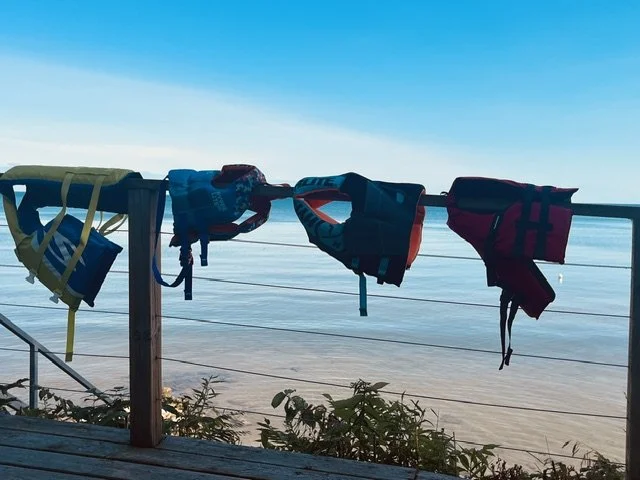
When we pull into the driveway now, our routine hasn't changed at all. The bags still end up in the entryway. The groceries still only half make it to the kitchen before someone is asking how quickly we can get down to the beach. By the end of the day, there are damp towels draped over the deck railing, life jackets drying in the sun and sand tracked through the house despite everyone's best intentions. A record will probably find its way onto the turntable before dinner, and if the weather is nice, we'll linger outside long after the plates have been cleared, watching the last light settle over the lake.
It's a rhythm we've come to love. The only difference now is knowing that another family may have experienced that same feeling just a few days before. They may have watched the same sunset from the deck, wandered down to the water with tired kids after dinner or discovered a favourite little coffee shop in town that they'll make a point of visiting the next time they come back.
I used to think operating an Airbnb could only mean renting out a property. Now I think it's something much more personal than that. It is opening the door to a place that has become deeply meaningful to our own family and inviting someone else to experience it for a little while—not because it is perfect, but because it is real, genuinely lived in and thoughtfully cared for. Every improvement has been made with intention, every room has been designed to be enjoyed and every season has added another layer to the story of the house.
Looking back, I don't think we've ever been in the business of simply renting a lake house. I think we've been in the business of creating a place where people can slow down, reconnect with the people they're with and leave with memories that feel a little like our own. Operating it as a vacation rental has never made the lake house feel less like home. If anything, welcoming other families into it has made us appreciate even more what this place was designed to do.